Process

You need to know: what goes in, what comes out, and why it’s controllable.

Here’s the process: optimized for reliable operation, measurable performance, and data center-grade predictability.

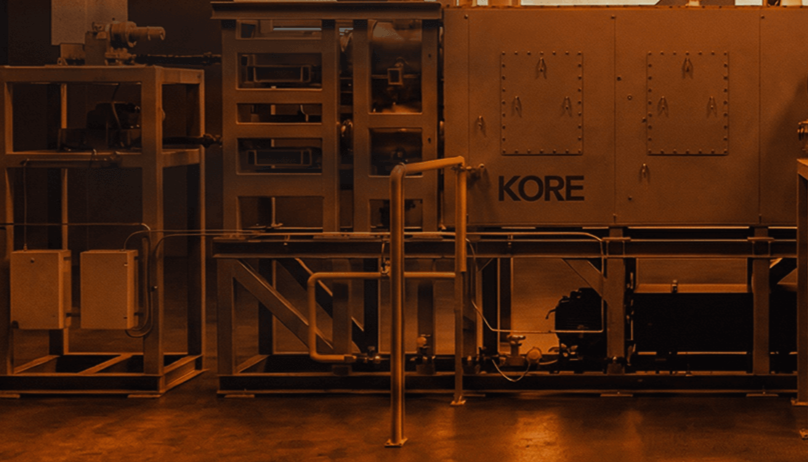
How the Kore MX-1 modular pyrolysis reactor turns waste into electrons

Step 1:

Feedstock Supply

Inputs Can Include:

✓ Diverted, landfill-bound organic waste (municipal and commercial organics)

✓ Agricultural residues

✓ Forestry residues and biomass (where applicable)

✓ Other eligible organic fractions based on site and permitting

The Key

Plentiful feedstock from over 1600 landfills nationwide = consistent output. Landfills
are a steady supply chain.

01

Step 2:

Material Handling

Feedstock is processed into a clean, consistent, reactor-ready input.

What happens in material handling:

Multi-stage sorting and pre-processing to remove metals, rocks, oversized debris, and other contaminants

Standardization + conditioning to neutralize variability across landfill organics and stabilize operations

Pelletizing (where used) to increase bulk density for steadier mass flow and higher yields per ton

The Key

Standardized material handling protects equipment, increases uptime, and makes output
predictable, improving operating margins.

02

Step 3:

High-heat pyrolysis (oxygen-free)

The core conversion happens in an oxygen-free environment:

✓ No combustion

✓ Closed-loop thermal conversion

✓ Controlled process conditions designed for consistent gas production

The Key

Controlled conditions enable repeatable conversion and consistent gas output that turns into
consistent power output.

03

Step 4:

Gas cleanup and conditioning

Produced gas is cleaned and conditioned for downstream use:

✓ Removal of impurities as required for the chosen output pathway

✓ Conditioning for stable operation and compliance

✓ Instrumentation and monitoring for verification

The Key

Clean, conditioned fuel supports reliability and protects downstream equipment.

04

Step 5:

Outputs and routing

Depending on your site design and offtake strategy:

Electricity
routed to on-site generation, microgrid, or grid export

Biocarbon
handled as a stable carbon product supporting carbon-negative outcomes

The Key

you can design around what you need most: electrons, fuels, credits, or all three.

05

Step 6:

Controls, safety, and monitoring

Modular Pyrolysis Reactors are built out for modern operations:

✓ Real-time monitoring and process control

✓ Safety systems designed for industrial sites

✓ Data capture for compliance, reporting, and performance validation

The Key

If it can’t be monitored, it can’t be trusted. This is designed to be auditable.

06

Want the hard proof?

See Performance & Emissions